Published
Most private car sale scams in Ontario target the seller through payments that can be reversed or links that steal banking or card details. Stay safe by keeping chats on a trusted platform, never paying to “verify” anything, releasing the car only after your bank confirms funds, and finishing Ontario paperwork before handing over keys.

Most private car sale scams aim at the seller, not the buyer, and they work in one of two ways: a payment that looks real but isn’t, or a link that steals your card or banking details. You can avoid nearly all of them with four habits: keep the conversation on a platform you trust, never pay anyone to “verify” anything, release the car only against funds your own bank has confirmed, and hand over the keys only once the paperwork is done. This guide walks through the scams, the warning signs and a routine you can follow from the first message to the handover. On SmartMotors.ca, free listings, verified sellers and a secure messaging system (WhatsApp or phone) help you start from a safer place.
Start Your Sale on Safer Ground
List your car on SmartMotors.ca, an Ontario marketplace with verified sellers and secure messaging for buyers and sellers.
TL;DR
- The most common scams against private sellers are overpayment, fake e-transfer notices, fake vehicle history report links, and buyers who want to purchase unseen and send a “shipper”.
- A buyer who pays the full price with no haggling, can’t meet, or asks you to click a link or send ID is a red flag.
- Take payment as cash or a bank draft you watch being issued, or an e-transfer you confirm in your own banking app. Never refund an “overpayment”.
- Keep the keys until the funds have cleared, and complete the ownership paperwork properly.
- If you are targeted, report it to the Canadian Anti-Fraud Centre at 1-888-495-8501, and to the police if you lost money.
Table of Contents
- The scams that target private car sellers
- Warning signs in the first messages
- A safe routine, step by step
- Where SmartMotors.ca fits in
- If you’ve been targeted or scammed
- FAQ
- Sources
The scams that target private car sellers
A scam is only convincing when it fits a normal sale. Each of the following imitates a step a real buyer would take.
Overpayment
The buyer agrees to your price straight away, then sends a cheque, bank draft or e-transfer for more than you asked. There is always a story: an honest mistake, extra for shipping, a relative who will collect the car. The buyer then asks you to send the difference back.
The trap is timing. A cheque can be deposited and show as available in your account before the bank discovers it is counterfeit, and the bank then takes the full amount back from you. Driving.ca describes the overpayment scam and recommends a certified cheque or bank draft made out to the seller, ideally verified by your bank before the vehicle is released. It also says never to accept gift cards as payment.
The e-transfer overpayment and the fake notification
With Interac e-Transfer, the scam takes two forms. In the first, the buyer “accidentally” sends too much and asks for a refund, and the original transfer is then reversed so that only your refund was real money. RBC lists the red flags: an overpayment blamed on a typo, pressure to refund right away, and a buyer who won’t meet in person.
In the second, you receive an email or text saying a payment is waiting. You are told to click a link and sign in to your bank to “claim” it. The Canadian Anti-Fraud Centre (CAFC), run by the RCMP, warns that these fake e-transfer “payments” are really requests for funds from your account or phishing messages seeking your banking credentials. RBC adds that a sign-in page reached through a link, rather than your own banking app, is itself a warning sign.
The fake vehicle history report
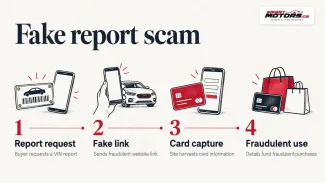
This one has grown quickly. The “buyer” says they are interested but first need a vehicle history report, and sends a link to a site that supposedly sells one cheaply. The site asks for your credit card details. The CAFC warns that fraudsters ask for a VIN report and send a link to a fraudulent website that harvests card information, which is then used for fraudulent purchases.
CBC News reported on the scam in 2023, quoting the CAFC’s Jeff Horncastle: the sites are “very convincing” and entering card and personal details puts sellers at risk of identity fraud. The RCMP’s Ladysmith detachment issued a similar warning in August 2025 about Facebook Marketplace sellers being lured to a fake site. The scam is still circulating, so treat it as current.
The rule is simple: a seller never pays for a report the buyer wants. If a buyer wants a history report, they can order it themselves using your VIN.
The unseen buyer and the “shipper”
The Ontario Provincial Police (OPP) warned in October 2026 about fraud on online marketplaces, including vehicle sellers approached by buyers who agree to buy without seeing the item and say they are out of town. The buyer then arranges for a third party to collect it. The OPP lists unsolicited offers, pressure to act immediately and requests for account credentials or identification as warning signs.
The CAFC likewise lists buyers who want to purchase without seeing the product first among the signs of fraud for online sellers.
The fake bank draft
A bank draft is a cheque issued by a bank, so people trust it. That trust is what forgers exploit. Calgary Police note that fake bank drafts and altered VINs are common scams in online vehicle sales. The protection is not to trust the paper, but to watch it being issued, as covered below.
The “I need your ID” request
Some scammers ask for a photo of your driver’s licence “to send the payment” or “to prove you’re the owner”. A real buyer doesn’t need that. Your ID can be used for identity theft, and the CAFC’s advice on identity fraud is to be cautious with any request for personal information you cannot explain.
Warning signs in the first messages
You can often spot a scam before you’ve spent more than five minutes on it. Be cautious if the buyer:
- offers your full asking price in the first message, with no questions and no haggling;
- says they are overseas, offshore or out of town and will send someone else;
- offers to send a cheque or bank draft by courier;
- offers extra money for your trouble or for shipping;
- sends a link to “confirm” banking details, claim a transfer or buy a report;
- asks for a photo of your ID;
- pushes you to move the chat off the platform and act quickly;
- shows a screenshot of a payment instead of a payment you can see in your own account.
The CAFC also recommends an online search to see whether the buyer has already been reported. A single flag doesn’t prove fraud, since plenty of honest buyers pay the asking price. But two or three together mean you should stop replying.
A safe routine, step by step
1. Start where sellers and listings are verified
Your first protection is the place you list. On SmartMotors.ca, listing is free, sellers and listings are verified, and buyers contact you through secure messaging by WhatsApp or phone. That keeps early conversations tied to a real listing for an Ontario vehicle rather than a vague private message with a stranger. You can list your car for free and keep your own phone number out of public view until you decide a buyer is real.
2. Publish the VIN and the facts, not your personal details
Put the make, model, year, mileage and price in the ad. Never put your home address, licence details or banking information in a listing or message. If you’d like buyers to arrive informed, SmartMotors.ca integrates CARFAX Canada reports, and our guide on how to read a CARFAX Canada report shows what a buyer will look for.
3. Meet in person, in public, and bring someone
A real buyer wants to see and drive the car. Pick a busy, well-lit place such as a bank branch or a police-service exchange zone if your local service has one. Ask a friend to come. Driving.ca advises going on the test drive yourself and checking with your insurer that prospective buyers driving your car are covered. For push-button-start cars, keep the key fob with you.
4. Choose a payment method you can verify yourself
The payment is where scams succeed, so be strict. Compare the options on one point: can you confirm the money is yours before the keys change hands?
| Payment method | What to do | Main risk |
|---|---|---|
| Cash | Count it at the meeting place, ideally at a bank branch where you can deposit it. | Counterfeit notes; carrying a large sum home. |
| Bank draft | Go with the buyer to their bank and watch the draft being issued. Take it into your hands before releasing the car. | Forged drafts; a call to a number printed on the draft may reach the forger. |
| Interac e-Transfer | Log in to your own banking app, never through a link, and confirm the money has arrived. | Fake notifications; bank limits that may be lower than the price. |
| Personal cheque | Avoid, or wait for it to fully clear. | Can bounce days or weeks later. |
| Gift cards, wire or money transfer services | Decline. | Impossible to recover. |
The advice from police and insurers is consistent. Calgary Police suggest going with the buyer to the bank and witnessing the draft being issued. McDonald’s Insurance recommends meeting at the buyer’s bank so a teller can verify a draft or instant transfer and confirm the funds have cleared. The same page says e-transfers should use automatic deposit and settle before keys are handed over, and that security-question e-transfers can be faked.
ICBC, British Columbia’s public insurer, says to accept only cash or a bank draft and to verify the draft with the issuing institution. The principle applies anywhere: contact the bank using a number you found yourself, not one printed on the document you were handed.
Whatever the method, never refund any “extra”. The rule from Canada’s banks, repeated across consumer guidance, is not to return an overpayment until you’ve confirmed the funds have fully cleared, and the honest answer to an overpayment is to cancel the sale.
5. Do the Ontario paperwork properly
In Ontario, a private seller needs the Used Vehicle Information Package (UVIP), the government document that records the vehicle’s registration history and lien information, plus a signed bill of sale. Our guide to the UVIP, its cost and the bill of sale covers what each contains, and the Ontario car selling checklist puts the whole handover in order.
Driving.ca’s paperwork guide says a bill of sale should carry both parties’ full names and contact details, the date, the VIN, make, model and year, the agreed price and both signatures, with two signed copies as good practice. It also says the seller should supply the original ownership document so the buyer can confirm that the VIN matches the car, a key step in avoiding fraud.
If you’re selling a car that needs work, state that in writing. Our guide to selling a car as-is in Ontario shows how to word it so the sale is clear to both sides.
6. Keep the keys until the sale is finished
Driving.ca advises never handing over the keys until ownership has been changed and you can see it in the new owner’s name. As long as the vehicle is registered to you, you may remain responsible for it, including for crashes and automated tickets. Don’t let a buyer take the car “to the bank” or “to a mechanic” before the money is yours.
Where SmartMotors.ca fits in
A safe sale starts with an audience of real local buyers. SmartMotors.ca is built for Ontario: listings are free to publish, you can filter and be found by city, price, brand, model, year, mileage and fuel type, and the site works in English and French, so a French-speaking buyer can ask questions in their own language. Buyers contact you through secure messaging by WhatsApp or phone, and an AI-powered search chatbot helps them find cars like yours.
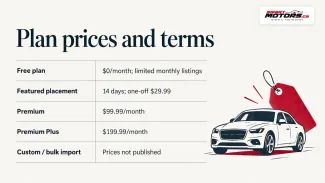
The Free plan costs $0 per month and has a limited number of monthly listings. If you want more visibility, a 14-day featured placement is a one-off $29.99. Dealers who list in volume can choose a membership: Premium is $99.99 per month and Premium Plus is $199.99 per month. Premium Custom and the bulk import service are available too, and their prices are not published on our site. Compare the plans on the SmartMotors.ca plans page.
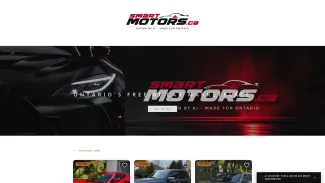
Buyers can also browse cars for sale in Ontario or in Toronto, which makes in-person viewings easy to arrange near you.
If you’ve been targeted or scammed
If a buyer shows the signs above and you stopped replying, you’ve done the right thing. Report it anyway: the CAFC asks people who were targeted but did not lose money to report it too, and it takes reports online or by phone at 1-888-495-8501.
If you did send money or share details:
- Call your bank or payment provider immediately to try to stop or reverse the transaction. This includes a credit card company if card details were entered on a fake report site.
- Keep the evidence. The Competition Bureau advises noting the person’s name, phone number and the exact website address, and keeping screenshots, receipts, cancelled cheques and copies of emails and texts.
- Report to your local police if money was lost, and keep the file number. Then report to the CAFC as well.
- Secure your accounts. RBC suggests scanning your devices, changing passwords, placing a fraud alert on your credit report, and locking or cancelling compromised cards.
- Report the listing or account to the platform where the buyer found you.
FAQ
What is the most common scam when selling a car privately in Canada?
The overpayment scam is the classic: a buyer sends more than the price and asks you to return the difference before their payment fails. Fake e-transfer notices and fake vehicle history report links are close behind. All three rely on you acting before your bank confirms the money.
Is an Interac e-Transfer safe when selling a car?
It can be, if you confirm the deposit yourself in your own banking app, never through an emailed or texted link. Use automatic deposit where possible, and release the car only after the funds have settled. Bank transfer limits vary, so check yours against the sale price.
Is a bank draft safe?
A bank draft is safer than a personal cheque, but drafts can be forged. Go with the buyer to their bank and watch the draft being issued, or have your own bank verify it, before you hand over the keys.
Should I send my ID or pay for a vehicle history report if the buyer asks?
No. Buyers who ask for a photo of your ID, or send a link to a report site that wants your card details, fit patterns the CAFC and RCMP have warned about. A buyer who wants a report can order one with your VIN.
Where do I report a car sale scam in Ontario?
Report it to your local police if you lost money, and to the Canadian Anti-Fraud Centre at 1-888-495-8501 or online. Tell your bank straight away, and report the account to the platform where the buyer contacted you.
Sources
- Driving.ca: Buying or selling a vehicle? Watch out for these scams
- Driving.ca: What paperwork do I need to sell or buy a car privately in Canada
- RBC: Spotting scams, e-Transfer scams
- Canadian Anti-Fraud Centre: Protecting yourself online
- CBC News: Selling your vehicle? Watch out for this scam
- RCMP Ladysmith: Beware of phishing scam, vehicle history reports
- OPP warning on online marketplace fraud (Renfrew Today)
- Calgary Police Service: Preventing vehicle theft and break-ins
- McDonald’s Insurance: How to sell your vehicle privately
- ICBC: Sell a used vehicle
- Competition Bureau Canada: How to report fraud and scams in Canada