Published
To sell a car privately in Ontario, start with the legal basics: get a UVIP, confirm the VIN matches your permit, and check for money owing. Then clean and photograph the car, write a listing with kilometres, repairs and history, and complete a safe handover with cleared payment, a signed bill of sale and the signed Application for Transfer (plus a Safety Standards Certificate when required).
To sell a car privately in Ontario, you need four things in order: the paperwork (a Used Vehicle Information Package, a bill of sale and a signed transfer), a clean and honestly described car, a listing with complete details and good photos, and a safe handover. This checklist walks through each one. When you are ready to advertise, you can list your car for free on SmartMotors.ca and reach Ontario buyers directly.
Reach Ontario Buyers With Your Listing
When your paperwork and car are ready, SmartMotors lets you upload vehicle details and photos to an Ontario-focused marketplace.
TL;DR
- Before you advertise, get a Used Vehicle Information Package (UVIP), confirm the VIN matches your permit and check for money owing on the car.
- At the sale you hand the buyer the UVIP, a signed bill of sale, the signed Application for Transfer and, when required, a Safety Standards Certificate.
- Gather service records, keys, the owner’s manual and a CARFAX report, then clean the car and photograph it in good light.
- Put mileage, repairs, accident history and extras in your listing, and meet buyers safely: check their licence, ride along on the test drive and confirm payment before you release the car.
- On SmartMotors.ca, a basic listing is free, and a 14-day featured placement costs 29.99 CAD one-off.
Table of Contents
- Step 1: Sort the legal essentials first
- Step 2: Know what you hand over at the sale
- Step 3: Gather the records buyers ask for
- Step 4: Decide whether to get a pre-sale inspection
- Step 5: Prepare the car itself
- Step 6: Take photos that sell
- Step 7: Write a listing that answers questions in advance
- Step 8: Choose where to list
- Step 9: Handle enquiries and viewings safely
- Step 10: Complete the handover
- Where SmartMotors.ca fits in your sale
- A one-page printable checklist
- FAQ
- Sources
Step 1: Sort the legal essentials first
The paperwork is where private sales stall, so start here. Ontario’s Ministry of Transportation, on its page for buying or selling a used vehicle (updated 18 June 2026), says a seller must do three things before the sale:
- Obtain a Used Vehicle Information Package (UVIP). This is an official report on the vehicle’s Ontario history. It is the document buyers expect to see. Our UVIP guide for sellers covers what it contains, what it costs and how the bill of sale section works.
- Check that the VIN matches the vehicle permit. The Vehicle Identification Number (VIN) is the 17-character code stamped on the car, usually visible at the base of the windshield and on the driver’s door frame. Compare it with the number on your permit. A mismatch will hold up the transfer.
- Check for money owing. If a loan or lien (a lender’s claim on the car) is registered against the vehicle, the buyer inherits a problem. Clear it, or settle it from the sale proceeds in a way the buyer can see, before you hand over the car.
Do these before you post an ad, not after you have a buyer. A buyer who finds out about a lien at the ServiceOntario counter will not come back.
Step 2: Know what you hand over at the sale
According to the same Ministry page, the seller gives the buyer:
- the UVIP
- a signed bill of sale
- a completed and signed Application for Transfer (it is on the back of your vehicle permit)
- a Safety Standards Certificate, when one is required
The bill of sale
The Ministry lists the details a bill of sale should carry: the VIN, make, year, power source (gas, diesel, electric and so on), body type, colour, model when available, the price, the names and addresses of both parties, both signatures and the date of sale. Fill in every line, and make two copies, one for each of you.
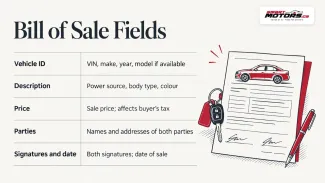
The price on the bill of sale matters for the buyer’s tax. Our guide to taxes on a used car in Ontario explains how the buyer’s tax is worked out and which exemptions exist, so you can answer the question buyers often ask about it.
The Safety Standards Certificate
A Safety Standards Certificate is an inspection certificate issued by a licensed mechanic. It is needed when the car is being registered for road use in a new owner’s name and has not been certified. Agree with the buyer, before you settle on a price, who is arranging it. Our guide to the Ontario Safety Standards Certificate covers what it covers, what it costs and its 36-day validity, which matters if your buyer is slow to complete the transfer.
Rules differ across Canada. In Alberta, for instance, the government says a private sale needs a bill of sale with the full names and addresses of both parties, the VIN, the vehicle description and cost, and both signatures. In British Columbia, ICBC says sellers must give the signed insurance and registration document and a completed transfer form to an Autoplan broker. This checklist follows Ontario’s process. If you live elsewhere, use your own province’s official page.
Step 3: Gather the records buyers ask for
Buyers pay more, and haggle less, when they can see the car’s history. CAA-Québec recommends collecting the owner’s manual, valid warranty documents, maintenance and repair invoices, rust-proofing certificates, proof of completed recalls and recent inspection reports. It adds that these records help show the odometer reading is consistent with the car’s history.
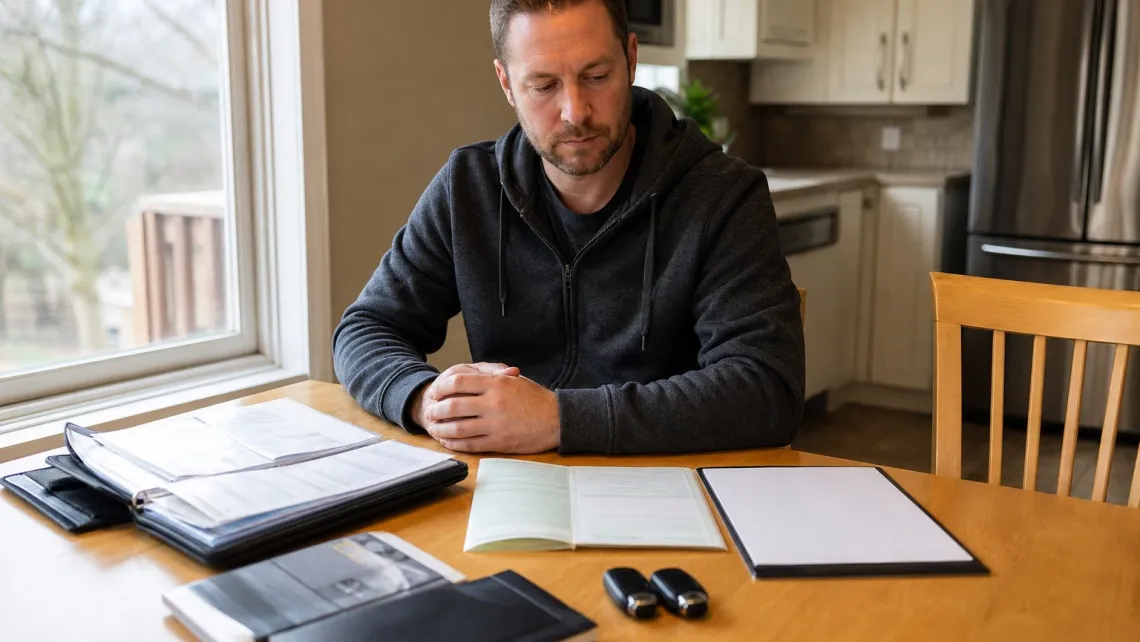
Set out a folder before the first viewing:
- Service and repair invoices, in date order
- Receipts for tires, brakes, batteries and any aftermarket parts
- The owner’s manual and every key and fob you have
- Warranty paperwork that is still valid
- Recall completion proof
- A vehicle history report
A CARFAX Canada report is the usual history report in Ontario. SmartMotors.ca integrates CARFAX Canada reports, and buyers can learn how to interpret one in our guide on reading a CARFAX Canada report. If your report is clean, say so in your ad.
Step 4: Decide whether to get a pre-sale inspection
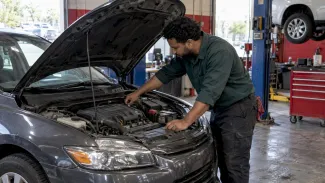
A mechanical inspection before you sell is optional. CAA-Québec says it is not mandatory, but it can show transparency, help you price the car, identify repairs and prepare answers to buyers’ questions. It is most useful when the car is older, has high mileage or has a warning light you cannot explain. A written report in your folder answers many questions before a buyer asks them.
Step 5: Prepare the car itself
Presentation affects how many people book a viewing. CAA-Québec’s advice is to vacuum the cabin and trunk, wash the interior and exterior, clean the rims and touch up paint where needed. Add these:
- Remove personal items. Clear the glovebox, door pockets, trunk and any toll transponder or phone mount.
- Fix the cheap and the safety-related. A burnt-out bulb, worn wiper blades or a low fluid level are quick jobs. A buyer who sees five small faults assumes there are bigger ones.
- Do not hide what you cannot fix. CAA-Québec advises disclosing unresolved problems. A dent or a warning light that you mention is a negotiating point. One the buyer discovers is a reason to walk away.
- Wash it the day of the viewing. A car that arrives clean at the first look sells faster.
A full detail can be worth it on a higher-value car, but a careful wash and vacuum covers most of the gain on an everyday vehicle.
Step 6: Take photos that sell
Photos are the first thing a buyer judges. CAA-Québec says the set should be current and clear, and should show the exterior from several angles, the interior, the dashboard, the odometer, the trunk, the tires and the engine compartment.
A practical shot list:
- Front three-quarter view, then rear three-quarter view
- Both sides, straight on
- Front seats, rear seats and the cargo area
- Dashboard with the engine running, so any warning lights are visible, and a close-up of the odometer
- Each wheel and tire
- Engine bay
- Any damage, shot honestly and close up
Shoot in daylight, in an open space, on a clean background. Overcast light is better than direct midday sun because it reduces glare and reflections.
Step 7: Write a listing that answers questions in advance
A complete listing brings serious enquiries and fewer time-wasters. CAA-Québec recommends stating mileage, maintenance history, major and recent repairs, winter tires, rust-proofing, modifications or accessories, accident history and whether a CARFAX report is available.
For an Ontario listing, add:
- Year, make, model, trim and fuel type
- Kilometres, in kilometres
- City, so local buyers can filter for you
- Whether the car is being sold with a Safety Standards Certificate
- Your asking price in CAD, and whether it is firm
- The number of keys and whether the owner’s manual is included
Look at similar cars before you set a price. Browse comparable cars for sale in Ontario filtered by year, mileage and city, and price within the range you see, with a small margin if you expect to negotiate.
Step 8: Choose where to list
SmartMotors.ca is built for Ontario buyers and sellers. Listings are free, with no hidden fees, and you upload your vehicle details and photos yourself. Buyers search by city, price, brand, model, year, mileage and fuel type, and the site works in English and French, so your listing reaches both language groups.
Here is what you get at each level, with the prices published on the SmartMotors.ca plans page:
| Option | Price | Good for |
|---|---|---|
| Free | 0 CAD per month | One-off private sellers with a car or two |
| Featured ad, 14 days | 29.99 CAD one-off | Extra visibility for a single car |
| Membership: Premium | 99.99 CAD per month | Sellers and small dealers with higher listing volumes |
| Membership: Premium Plus | 199.99 CAD per month | Dealers with larger inventories |
| Premium Custom and bulk import service | No published price | Dealerships importing their stock in bulk |
The free plan has a monthly limit on listings, which suits a private seller with one car. Buyers contact you through secure messaging, by WhatsApp or phone, so you decide how much of your number you share. If you want extra exposure for a car that must sell quickly, a featured placement puts it in front of more buyers for 14 days.
Dealers who want exposure without per-ad fees can start on the free plan, then move to a membership or the bulk import service as the stock grows. Our site’s user reviews show how other sellers have used it.
Step 9: Handle enquiries and viewings safely
Most problems in private sales happen at first contact or at payment, so set your rules before the first message.
- Meet in a public place in daylight, and bring someone if you can.
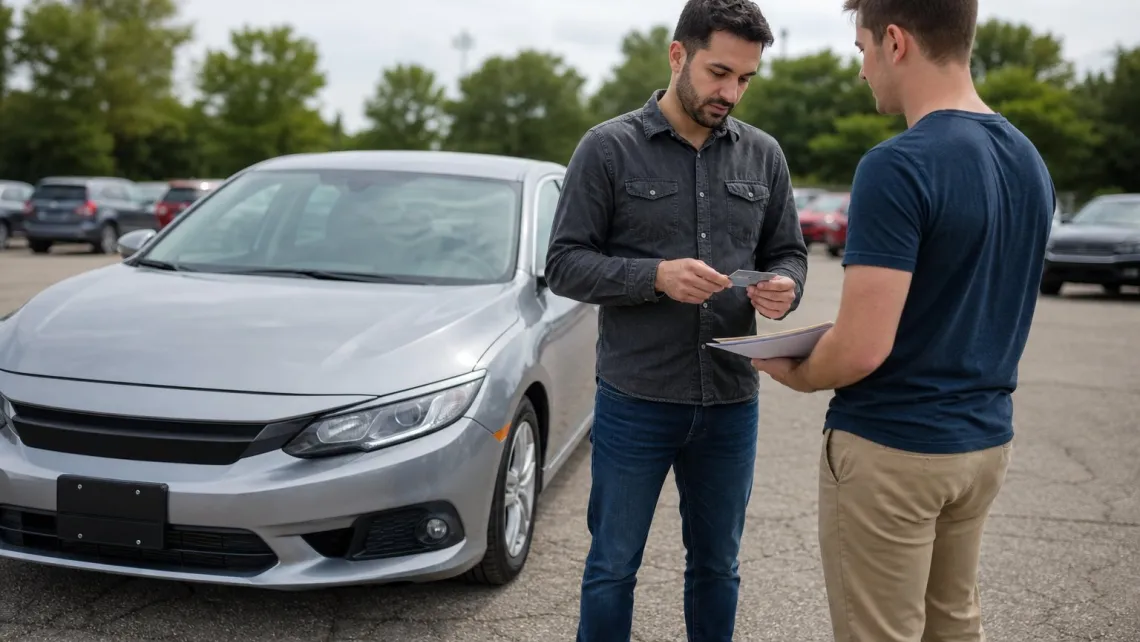
- Check the licence. CAA-Québec advises seeing a valid driver’s licence before any test drive.
- Ride along. CAA-Québec recommends accompanying the buyer. It says a drive of about 15 to 20 minutes on different road types is generally enough to evaluate a car.
- Keep your communication in one place. Use the platform’s messaging, WhatsApp or phone, so there is a record of what you agreed.
- Be wary of unusual payment requests. The same CAA-Québec guide warns against fake bank drafts and any request for your personal banking information.
Confirm payment before anything else changes hands. CAA-Québec’s advice is to confirm that payment has been received and complete the transfer before releasing the car. In practice, that means funds that have cleared in your account, not a screenshot of a transfer.
Step 10: Complete the handover
On the day of the sale, work through this list with the buyer:
- Confirm payment has cleared.
- Sign the bill of sale, and each keep a copy.
- Complete and sign the Application for Transfer on the back of the vehicle portion of the permit.
- Give the buyer the UVIP, and the Safety Standards Certificate if one applies.
- Hand over all keys, the manual and the service records.
- Take your plates off the car if you plan to keep them. The Ministry’s page explains plate rules for the seller and buyer, so read it before the handover.
- Cancel or transfer your insurance once the car has left your possession, and tell your insurer the sale date.
- Take down your listing so no further enquiries arrive.
The buyer then takes the documents to ServiceOntario to register the car in their name. Registering is the buyer’s job, but your signed documents are what make it possible.
Where SmartMotors.ca fits in your sale
The checklist above takes a few evenings. The listing step is the part we can make easy: you upload your car’s details and photos, it appears in filtered searches by Ontario buyers, and verified sellers and listings help buyers trust what they see. A free listing costs nothing, and if you want a car in front of more buyers, the 14-day featured option is 29.99 CAD. See the plans and start your listing.
If you prefer to work in French, the same service is available at smartmotors.ca/fr.
A one-page printable checklist
Before listing
- UVIP obtained
- VIN matches permit
- Lien and money-owing check done
- Safety Standards Certificate arranged or buyer’s responsibility agreed
- Service records, keys, manual and CARFAX report gathered
Preparing the car
- Interior and exterior cleaned, rims done, paint touched up
- Small repairs done, larger faults noted
- Photos taken in daylight, covering every angle in Step 6
Listing
- Kilometres, repairs, accident history, tires, extras and CARFAX status stated
- Price set against similar Ontario listings
- City and fuel type completed
Selling
- Licence checked, test drive accompanied
- Payment cleared
- Bill of sale and Application for Transfer signed
- UVIP and certificate handed over
- Insurance updated, listing removed
FAQ
Do I need a UVIP to sell my car privately in Ontario?
Yes. Ontario’s Ministry of Transportation says sellers must obtain a UVIP and give it to the buyer along with the signed bill of sale and Application for Transfer. Get it before you advertise, so you can show it to serious buyers at the first viewing.
Who pays for the Safety Standards Certificate?
Ontario’s rules require a certificate when one is needed for registration, but the seller and buyer can agree who arranges it. Settle this before you agree on a price, because it affects what each side pays. Our certificate guide explains the cost and the 36-day validity.
Do I have to go to ServiceOntario to sell my car?
The seller completes and signs the documents, and the buyer registers the car in their name at ServiceOntario. The Ministry’s page lists the documents you provide, and its UVIP can be ordered ahead of time.
What should I put in my car listing?
State the kilometres, service history, recent repairs, tires, rust-proofing, modifications, accident history and whether a CARFAX report is available. Add your city, fuel type and price in CAD. Complete listings draw fewer pointless questions.
Can I list my car for free?
Yes. SmartMotors.ca offers free listings with no hidden fees, and the free plan has a monthly limit on the number of listings. Higher volumes need a membership, and a featured placement is an optional one-off payment.
Sources
- Buy or sell a used vehicle in Ontario, ontario.ca
- How to sell your car privately, CAA-Québec
- Comment vendre sa voiture soi-même, CAA-Québec
- Standard bill of sale, Alberta.ca
- Sell a used vehicle, ICBC