Published · Updated
Summary
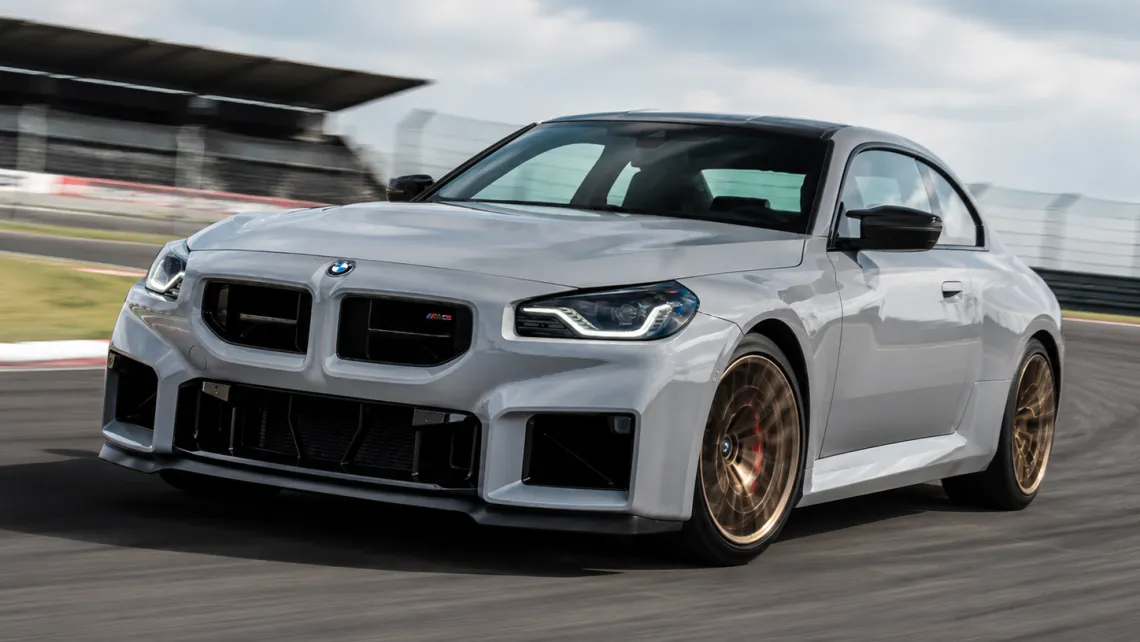
After a five-year wait, the M2 CS is back — and it might be the most important BMW M car of the decade. With 523 horsepower from a recalibrated S58 twin-turbo inline-six, nearly 100 pounds shed off the standard M2, a lowered chassis, carbon-fiber everywhere, and a 188-mph top speed, the 2026 M2 CS arrives at a moment when most of BMW M’s lineup is getting heavier, more electrified, and more removed from the analog driving experience that built the brand’s reputation. It’s small. It’s rear-wheel drive. It uses a real combustion engine. And at $99,775 USD it’s almost certainly one of the last M cars that will ever be all of those things at once.
This post breaks down what the M2 CS actually is, what BMW changed versus the standard M2, the controversial decisions (no manual, no carbon hood, automatic only), what it’s like at the limit based on the first reviews, how it compares to its rivals, and whether the $30,000 premium over a base M2 is worth it. If you’ve been waiting for BMW to remember what made it BMW, this is probably the answer — and the last answer.
Why the M2 CS Matters Now
BMW M is in the middle of an identity transition. CEO Frank van Meel has confirmed roughly 30 new M and M Performance models by 2029, spanning gas, plug-in hybrid, and fully electric drivetrains. The next-generation M3 is coming in both inline-six and electric flavours. The M8 is being phased out, with M850i production ending in April 2026. The XM is rumoured to bow out before the decade closes. The brand is moving — fast — toward bigger, heavier, more electrified cars.
Against that backdrop, the M2 CS is a deliberate throwback. It’s the smallest, lightest M car. It’s rear-wheel drive. It runs the same S58 twin-turbocharged 3.0L inline-six that powers the M3 and M4, here cranked up to 523 hp. There’s no hybrid system, no battery pack, no all-wheel drive option, no four-door variant. It’s the spiritual successor to the E46 M3 CSL and the 1M Coupe — small, focused, expensive, and not built to please everyone.
For enthusiasts who’ve spent the past decade complaining that modern M cars have gotten too heavy, too digital, and too far from their roots, this is the car they’ve been asking for. It’s also, very likely, the last one they’ll get.
What’s New: The Numbers
Here’s the short version of what changes when you step up from the regular M2 to the CS:
- Power: 523 hp (up from 473 hp on the 2025 M2). That’s a 50-hp bump from a retuned S58 inline-six.
- Weight: up to 97 pounds lighter than the standard M2, with optional carbon-ceramic brakes cutting another 40 lb.
- 0–60 mph: 3.7 seconds with the 8-speed automatic.
- Top speed: 188 mph with the M Driver’s Package.
- Chassis: lowered by 1/3 of an inch, with revised steering, suspension geometry, and damping.
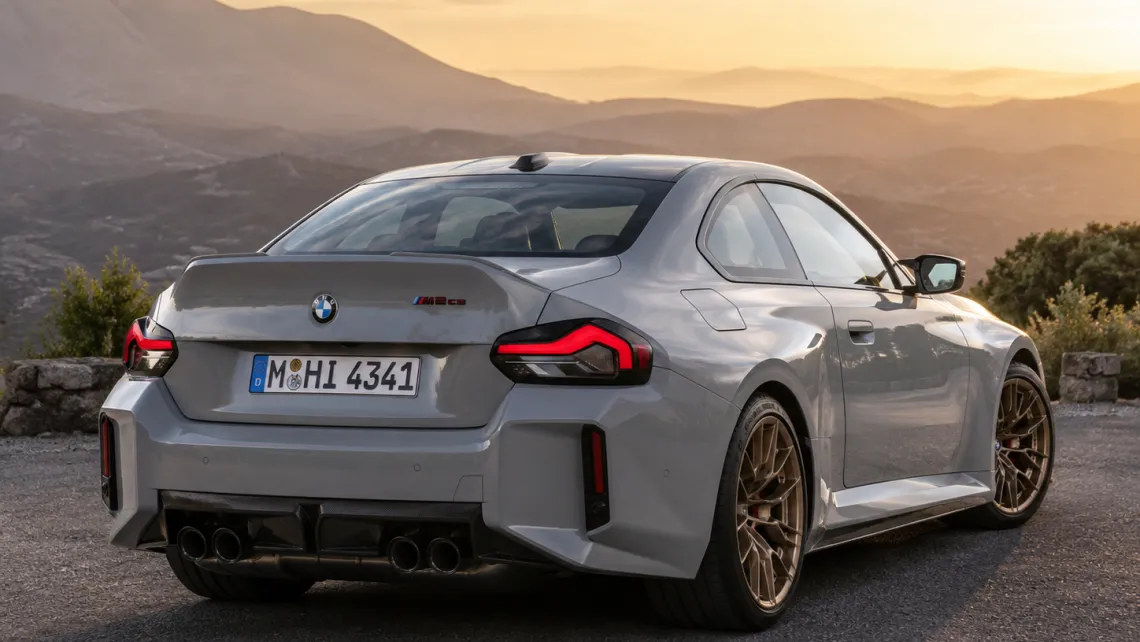
- Wheels: 19 inches front, 20 inches rear in a matte bronze finish exclusive to the CS.
- Price: $99,775 USD including the $1,175 destination charge — roughly $30,000 over a base 2026 M2’s $68,200 sticker.
- Production: limited, though BMW hasn’t published exact numbers.
The CS badge (“Competition Sport”) traces back to the BMW 3.0 CS and 3.0 CSL of the early 1970s, and the modern formula is consistent across the M3 CS, M4 CS, and M5 CS that came before it: add power, remove weight, sharpen the handling, charge a premium, build a limited run.
The Engine: S58 Unleashed
The S58 is one of the best engines BMW M has ever built, and the CS version is its most aggressive tune yet outside the M4 CSL. The 3.0L twin-turbocharged inline-six has been recalibrated for higher boost pressure and a more aggressive throttle map, with revised cooling to handle sustained track use.
In the CS, peak power arrives later in the rev range than on the standard M2, and the torque curve feels noticeably more frantic — early reviewers describe a top end that pulls harder and longer, with a sound that’s been opened up via a less restrictive sport exhaust. It’s not as raw as a naturally aspirated S65 from the E92 M3, but it’s closer to that character than any modern M car has come in a long time.
Power runs exclusively through an 8-speed M Steptronic automatic to the rear wheels. There’s a launch control function, paddle shifters formed from carbon fiber, and a true rear-wheel-drive layout — no xDrive option, no AWD safety net.
The Chassis: Where the Money Went
If you only read the spec sheet, the M2 CS looks like a power-and-weight tune. Drive it and the chassis changes are the bigger story.
BMW lowered the car by roughly 8 mm, retuned the adaptive M dampers, stiffened the engine and gearbox mounts (an old M3 CSL trick that transmits more drivetrain vibration into the chassis — annoying on a commute, brilliant on a track), revised the steering ratio and effort curves, and recalibrated the M Differential. The brakes are larger, with optional carbon-ceramics that save 40 lb of unsprung weight.
First-drive impressions from Michelin’s Laurens Proving Grounds in South Carolina describe a car that’s noticeably tighter and more responsive than the standard M2, with steering that loads up more naturally and a rear axle that’s easier to read at the limit. The standard M2 was already one of the most engaging modern BMWs; the CS is the version that earns its asking price by being communicative in a way the regular car can’t quite match.
It is not, however, a track-only car. BMW has been clear that the CS is meant to work as a daily driver too, and the ride — while firm — isn’t punishing in the way an M4 CSL is.
The Diet: Carbon Fiber Where It Counts
To get to that ~97-lb weight loss, BMW used carbon-fiber-reinforced plastic (CFRP) in several key places:
- Roof panel
- Mirror caps
- Ducktail-style decklid (a CS signature)
- Centre console / transmission tunnel
- Front splitter and rear diffuser elements
- Shift paddles
- Seat shells
Notably absent: a carbon-fiber hood and the yellow daytime running lights that have appeared on other modern CS models. BMW has openly said this was a cost decision — adding the hood would have pushed the car well past the $100,000 base price, and the company wanted the CS to stay (just barely) under that line. Whether that was the right call is a fair debate.
The other addition is an LED-lit CS logo that glows from behind the door cards when you enter the cabin, with matching illuminated CS logos in the headrests. It’s pure theatre, and it works.
The Cabin: Track-Focused, Not Stripped
Inside, the M2 CS gets carbon-fiber sport seats with integrated headrests, an Alcantara-wrapped steering wheel, and CS-specific trim. BMW’s iDrive 8.5 runs on the curved display, with a full-colour head-up display and a Harman Kardon sound system included. Trunk space stays at a usable 13.8 cubic feet — this is still a real car, not a stripped-out homologation special.
The track-focused tech is where it gets serious:
- 10-stage M Traction Control — lets the driver dial in exactly how much wheelspin is allowed before intervention.
- M Drift Analyzer — measures drift angle, distance, and duration, with a score readout.
- M Laptimer — built-in lap timing with sector splits.
- Optional M Drive Professional features including Drag Mode and configurable telemetry overlay.
The interface is genuinely useful on a track day, not just marketing. You can preset two completely different chassis-and-powertrain configurations to the red M1 and M2 buttons on the steering wheel and switch between, say, a comfortable street setup and a full-attack track mode with a single press.
The Manual Transmission Question
The single most contentious decision on the M2 CS is this: it’s automatic only. The standard 2026 M2 still offers a six-speed manual. The CS does not.
BMW’s reasoning is partly performance (the 8-speed is faster, more consistent on a track, and works with launch control), and partly the reality that take rates on manual M cars are now in the single-digit percentages even among enthusiasts. The economic case for engineering a manual into a limited-production halo car is thin.
The emotional case against that decision is much stronger. The M2 has been the BMW that enthusiasts pointed to as proof BMW M still cared about three pedals. Taking the manual out of the CS — the most “purist” version of that car — is the kind of decision that sparks lengthy forum threads. Some buyers will walk away over it. Others will accept that the 8-speed automatic is genuinely excellent, faster than any human with a clutch, and stop worrying about it.
If you want a manual M car in 2026, the standard M2 is your answer. The CS isn’t.
How It Compares
At $99,775, the M2 CS sits in an awkward but rich corner of the market. A few benchmarks:
- Standard 2026 BMW M2 ($68,200): Same engine architecture, 50 fewer hp, ~100 lb heavier, manual available. About 70% of the experience for two-thirds of the money. For most buyers, this is the smarter purchase.
- 2026 BMW M4 Competition (~$80,000): More power, more comfort, more rear-seat room, all-wheel drive available. Faster on paper. Less engaging on a back road.
- Porsche 718 Cayman GT4 RS (~$165,000): The naturally aspirated, mid-engined alternative. A more focused track tool, but vastly more expensive and harder to live with daily.
- Porsche 911 Carrera (~$130,000+): A more grown-up, more refined sports car. Less raw, more usable, more expensive.
- Audi RS 3 (~$70,000): The all-weather pocket rocket. Faster point-to-point in bad weather, less special on a great road.
The M2 CS isn’t the fastest car on this list, the most refined, or the best value. It’s the most engaging in the specific way old BMWs were engaging — a small, light, rear-drive coupe with a great inline-six and a chassis that talks to you. That’s a narrower brief than it sounds, and it’s exactly what BMW M designed it to do.
Should You Buy One?
A few honest filters:
You should buy an M2 CS if: - You’ve owned multiple BMWs, and the ones you remember fondly are the ones with manual gearboxes, naturally aspirated engines, and small footprints. - You drive enough back roads or track days that the chassis upgrades over a standard M2 will actually matter. - You’re comfortable spending $100,000 on a car you’ll probably keep for a long time, because resale on limited-production CS models tends to hold up unusually well.
You should buy a standard M2 instead if: - You want a manual gearbox. - You don’t track the car. - You’d rather have $30,000 in the bank, a new set of winter tires, and a fun summer trip.
You should buy something else entirely if: - You need all-wheel drive for a real winter (an M3 xDrive or M4 Competition xDrive makes more sense). - You want a back seat that adults can sit in. - You’re cross-shopping naturally aspirated mid-engined cars and have the budget for a Cayman GT4 RS.
The Bottom Line
The 2026 M2 CS is a deliberately old-fashioned car built by a company that knows the era of cars like this is ending. It’s the lightest, smallest, most rear-drive-focused, most analog M car you can buy new in 2026. It’s also $99,775, and it’s probably going to be remembered the way the E46 M3 CSL is remembered — as the last good one before everything got too big, too heavy, and too electric.
If you want one, don’t wait long. BMW hasn’t announced production numbers, but every previous CS has been built in limited quantities, and demand for this one is already running ahead of supply. Five years from now, the standard M2 will be the affordable one and the CS will be the unicorn. Buy accordingly.
See you on the back road.